It knows more than it can morally bear
— From the Overture
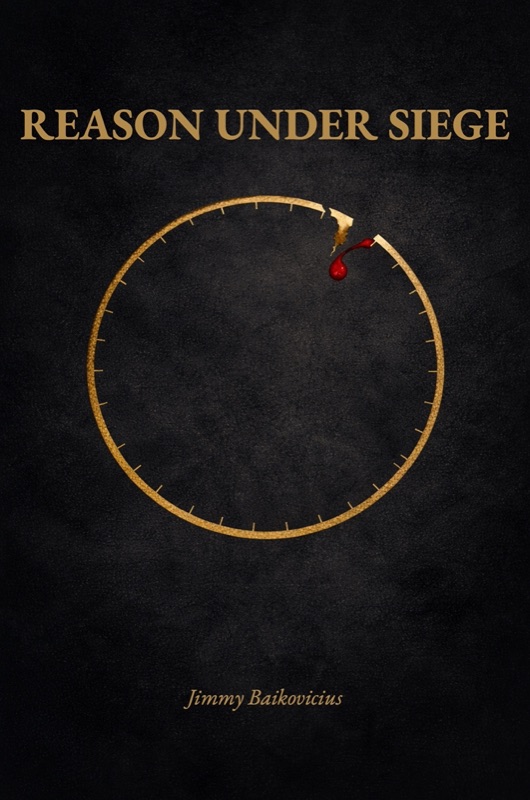
Reason Under Siege
Want me to let you know when it's published?
Anticipated reason precedes the fact.
The word that convicts before examining defends nothing: it supplants.
Peace is the integrity of the sequence.
Violence triumphs by amputating the sequence.
Reason awakens by compelling to appear
what the scene omitted.
Territory of the siege:
Violence exceeds the episode: it is system.
War abandons anomaly: it is sequence.
News abdicates the record: it is operation.
Peace renounces desire: it is infrastructure.
Reason refuses possession: it is an organ under siege.
From Reason Under Siege · Jimmy Baikovicius
The argument
Reason Under Siege summons twenty canonical sages—from Heraclitus to Arendt—to diagnose the contemporary collapse of judgment: the word that supplants the fact, the memory administered as a weapon.
The verdict precedes the fact. Propaganda leaves the conscience intact and displaces the seat from which it judges. The algorithm ranks the gaze. What holds it rises. The machine makes advantage a sovereignty. Our hour chooses between dignity and efficiency.
The Portico
The book opens with five thresholds that reframe the problem before the voices are summoned:
I. The Siege — screen, noise, simulacrum: the siege of judgment.
II. The Cage — ideology, sacralisation, abolition of the face.
III. Toward Silence — books, lucid air, the relearning of judgment.
IV. Calibrating the Instrument — method, a constellation of voices, strategy.
V. The Labyrinth and the Thread — the mission: to return with judgment and method.
Architecture of the book
Twenty sages summoned in three sapiential movements, articulated by five thresholds of passage up to the regime of the present:
Movement I · Conflict
The elemental physics of force
Heraclitus · Democritus · Thucydides · Pericles · Spinoza
Movement II · Power
Anatomy of the State: from tribe to contract
Ibn Khaldun · Machiavelli · Hobbes · Locke · Rousseau
Movement III · Order
Strategies of defense for a mind under siege
Ockham · Moses · Popper · Camus · Eco
Axial · The Synthesis
Keystone: limit, responsibility and tragedy
Vigil · The Burning Question
They keep vigil against the sleep of the slogan
Girard · Ricoeur · Hayek/Holland · Arendt
Automaton · The Machine
The algorithmic regime
The Inverse Theologian · The Algorithmic Mirror · The City of the Machine
Colloquy · 20 Voices
The appearance before the syntax of the age
Symposium in the Clearing · The Axial Rose · Post-Scriptum: The Verdict
The Present · Siege
When time ceases to pass
Anticipated Reason · The Anticipated Verdict · Power Under Siege · Organized Permanence · The Individual Under Siege
Summit · Reason Under Siege
The book culminates in Golden Reason: the full enunciation of the doctrinal diamond that runs through the work.
Fragment
The fact no longer arrives first.
It arrives to confirm a sentence.Anticipated reason does not alter strategy alone. It alters judgment.
Where power precedes the act, conscience learns to precede the proof.
The fact appears late. Before its appearance, a scene already awaits it, an emotion already translates it, a belonging already knows what it must mean.
The verdict, once a conclusion, is now the condition of reading.
— From the chapter The Anticipated Verdict of Reason Under Siege · Jimmy Baikovicius
The Plates
Perhaps the blade keeps cutting through the fog, and in doing so, it regulates.
— Carlos Ott
The book includes unpublished works in graphite and watercolor by the architect Carlos Ott, whose aesthetic doctrine accompanies the argument.
About the author
Engineer, doctorate from McGill University. More about the author.
In editorial preparation.
Bilingual edition: English and Spanish.
Forthcoming.